That stiff drawer. That door that won’t close flush. That gap you’ve been ignoring. Your wardrobe is trying to tell you something. Here are the five signs of poor joinery — and what proper craftsmanship actually looks like.
You spent good money on a custom wardrobe. It looked fine for the first few months. But now? A door hangs slightly off. A drawer sticks. The edge tape is lifting. And every time you close it, there’s a hollow rattle that wasn’t there before.
You’re not imagining it. These are symptoms of compromised joinery — and they only get worse.
Sign 1: Doors That Don’t Sit Flush
Open your wardrobe and look at the doors from the side. Do they align perfectly, or does one sit slightly forward, slightly back, slightly tilted? Misalignment is the most visible sign of imprecise cutting. When panels are measured and cut by hand rather than by CNC machine, tolerances drift. A millimetre here, two there — and suddenly nothing lines up.
Kayjah’s ZBOM cabinetry is cut to 0.1mm precision on automated production lines. That’s not a selling point — it’s a manufacturing standard that should be non-negotiable for any wardrobe above KES 200,000.
Sign 2: Edge Banding That’s Peeling
Run your finger along the edges of your shelves and panels. Feel any roughness? See any tape lifting? Hand-applied edge banding — the kind done with a domestic iron and contact adhesive — starts failing within months. Moisture gets underneath, the adhesive weakens, and the tape curls.
Factory edge banding uses industrial hot-melt adhesive applied at precise temperatures with consistent pressure. The bond is molecular, not mechanical. It doesn’t peel because it was never just stuck on — it was fused.
Sign 3: Hinges That Creak or Sag
Soft-close hinges should do exactly that — close softly, every time, for years. If your wardrobe doors slam, resist closing, or have started sagging downward, the hinges were either poor quality or incorrectly installed. Cheap hinges lose their hydraulic resistance within a year. Properly specified hinges from brands like Blum or Hettich are rated for 200,000 cycles — roughly 27 years of daily use.
Sign 4: Drawers That Stick or Wobble
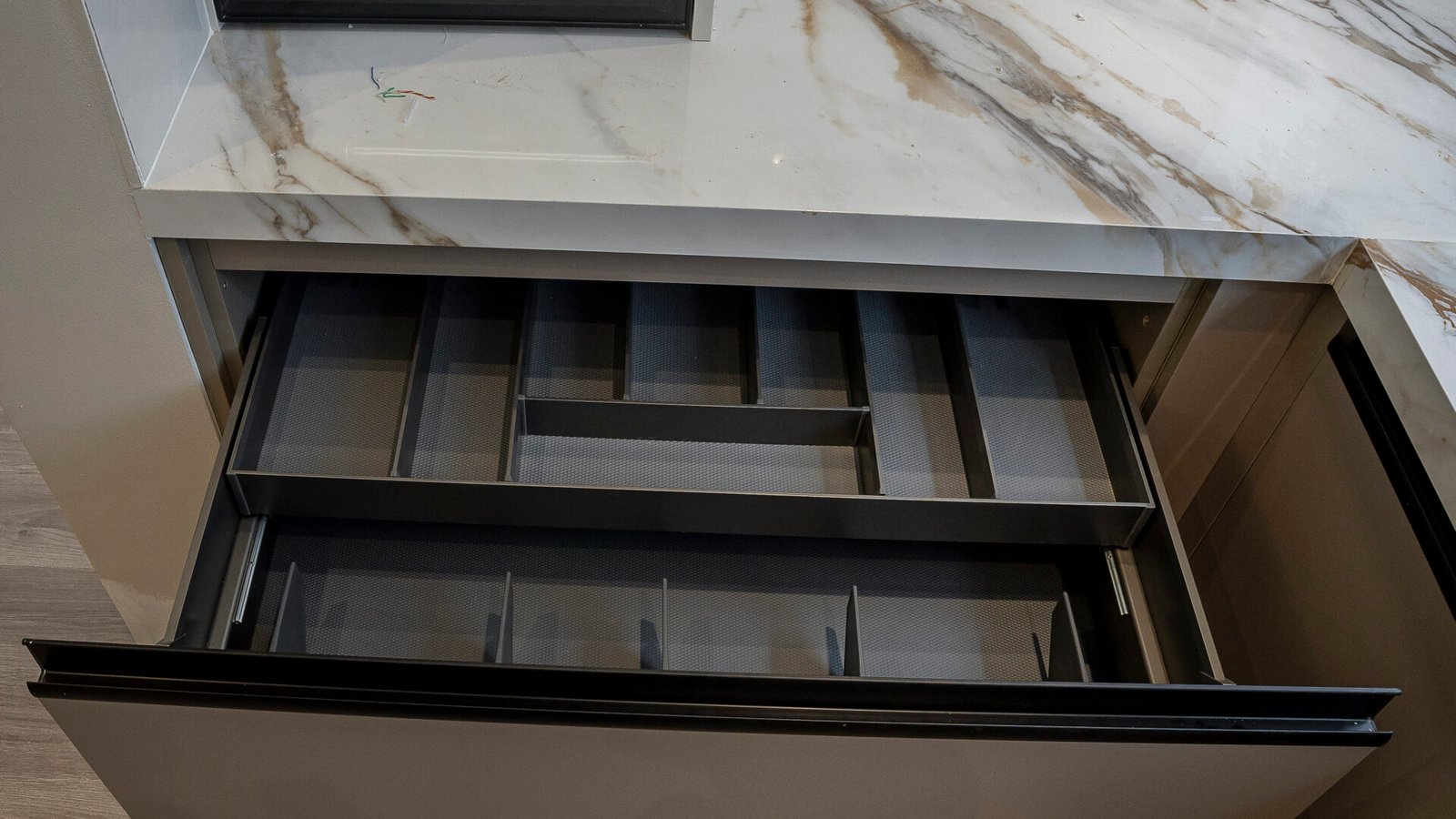
Pull a drawer out slowly. Does it glide, or does it catch? Push it side to side. Does it wobble? Drawer runners are the unsung heroes of good joinery. Bottom-mount plastic runners — the kind found in budget furniture — wear out fast and offer no lateral stability. Full-extension, soft-close metal runners transform the experience entirely.
Sign 5: The Hollow Sound
Knock on a panel. If it sounds hollow and thin, the board is likely a low-density chipboard with a melamine wrap — not the solid engineered board it was sold as. Density matters. It affects structural integrity, screw-holding strength, and acoustic quality.
Can It Be Fixed?
Some issues — hinge replacement, runner upgrades — can be retrofitted. Others, like warped panels and delaminated edges, require full panel replacement. The honest truth: if three or more of these signs are present, you’re usually better off starting fresh with a properly engineered system than patching a fundamentally compromised structure.
At Kayjah, we design wardrobes where none of these conversations need to happen. Because the conversation should be about what you love about your space — not what’s failing in it.